Entering the second half of semester

lilijia Posted in AOPS_Counting_Probability, SAT math
Comments Off on Entering the second half of semester

Dear all,

Daylight saving time ends this Sunday. Your clocks are moved an hour back at 2AM on 11/3.

For my AoPS Counting & Probabilities class: In the first half of the fall semester, we have learned Countings. Since tomorrow, students are going to explore the strategies in finding Probabilities.

Here is one “warm-up exercise”: On Friday night, there is a 60% chance that Becky will see a shooting star in any given hour. If Becky watches the sky for 2 hours, what is the probability that she’ll see a shooting star?

For my SAT Math class, we are going to deep dive into the model construction and equation solving in the following weeks. Please be prepared!

Enjoy and see you soon!

Best,
Lijia

Daylight Savings: fall back with a clock and pumpkin

AoPS_CP Week 7: Midterm Exam

lilijia Posted in AOPS_Counting_Probability
Comments Off on AoPS_CP Week 7: Midterm Exam

Summary:

We took the midterm exam today, covering Chapters 1 to 6 (Countings). Congratulations to Annabelle, Jason, and Susan for being Top 3 this time! (Max is absent because of his contest). Keep up the good work!

If you feel upset about the score, do not give it up. What more important is to learn from the mistakes, and find the area of improvement. Look ahead. I am looking forward to your progress in the following months!

Here is the link to the answer key.

Here are some pictures of the board-writings in our second period (解题课), to help you make corrections.

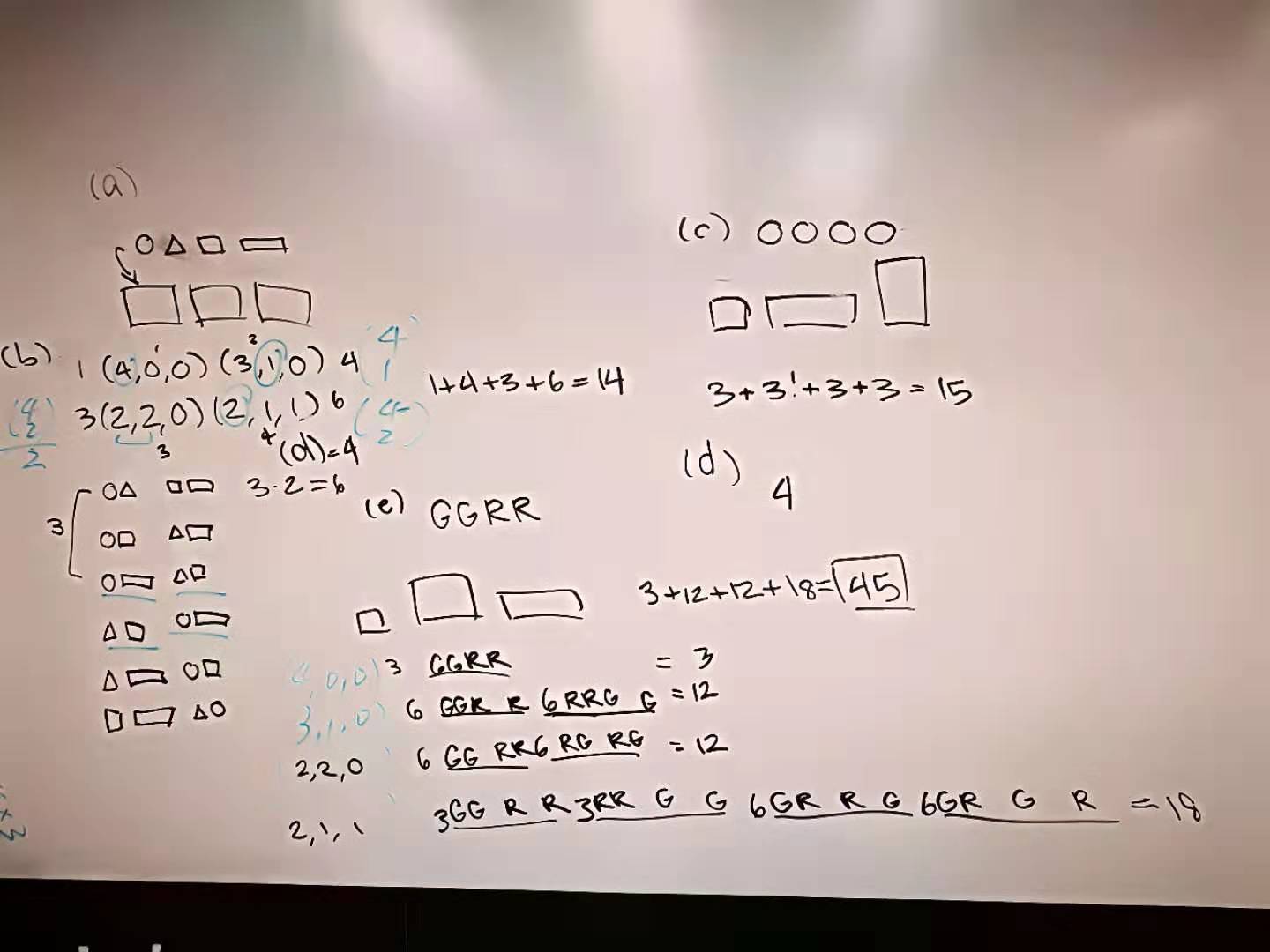
Midterm Q15

The first picture is for Question 15. Thanks a lot to Annabelle for explaining it very clear to the class!!

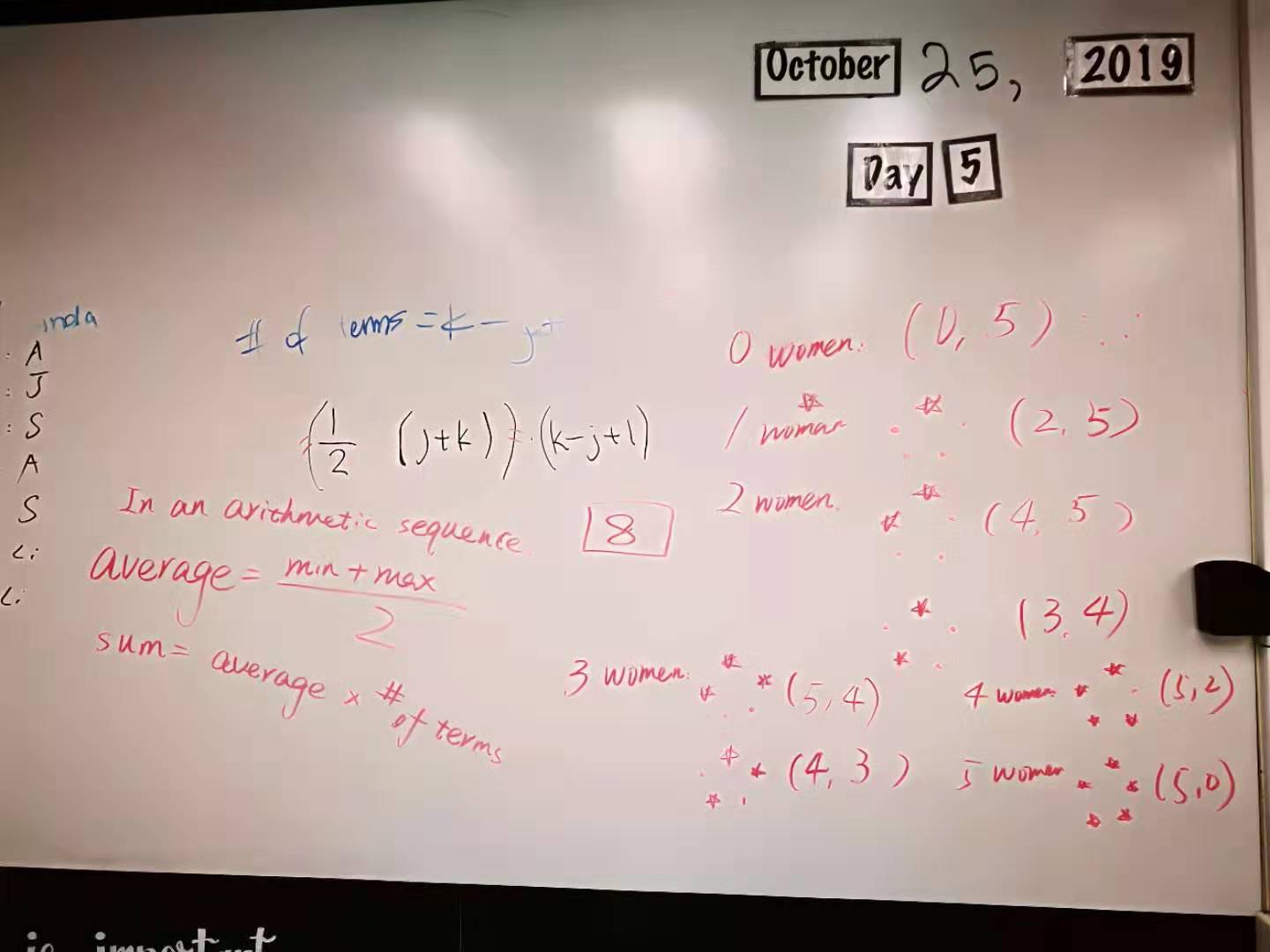
Midterm Q18

The second picture is for Bonus Question 2. The star represents women, and the dot represents men. Please feel free to reach out if you have any questions.

Homework:

1. Make corrections to the test (Use a different color).

2. Preview Chapter 7: Introduction to Probability


See you next week!

AOPS_CP Week 7

lilijia Posted in AOPS_Counting_Probability
Comments Off on AOPS_CP Week 7

Welcome back, everyone!

Lesson Review_Chapter 6: Some Harder Counting Problems

Tips:

1. Plug in some numbers for variables, solve, and look for a pattern.

2. Try to solve a simpler version of the same problem.

3. Be flexible. Try different approaches.

Homework:

1. Page 109, Ex 6.8 to 6.12 (only 5 problems this week)

2. Review (pay special attention to the corrections to the previous problems), and get prepared for the midterm exam on 10/27. Good luck!

Course Roadmap:

In the first half of the fall semester, we have gone through the “counting part” (Can you remember the “counting strategies” we have learned so far? For example, the complementary method vs. the constructive method? Correcting the overcounting strategy, and so on). After the midterm exam, we will discuss “probabilities”. Have fun!


AOPS_CP Week 6

lilijia Posted in AOPS_Counting_Probability
Comments Off on AOPS_CP Week 6

Chapter 5: More with Combinations

Lesson Review

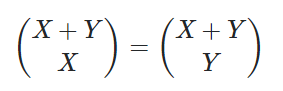
Paths on a grid: The solution to the general problem is if you must take X right steps, and Y up steps then the number of routes is simply the ways of choosing where to take the right (or up) steps. i.e.

Annotation 2019-10-13 233851

Combine the counting techniques: complementary counting or casework; overcounting strategies, and so on.

Distinguishability matters (see section 5.4, examples of the balls and boxes).


Homework

Page 83, Ex 5.2.1 (classwork), 5.2.2, 5.2.3,

Page 88, Ex 5.3.1, 5.3.2, 5.3.3, 5.3.5

Page 91, Ex 5.4.1 (classwork), 5.4.2, 5.4.3

Page 93, Ex 5.10

Extra Resources

I am very glad to see that our students are making steady progress, especially in the quality of the homework. Keep up the good work!

Look forward to meeting you all next week. We miss our dear friends Annabelle, Jasmine, and Julia today:)


AOPS_CP Week 5

lilijia Posted in AOPS_Counting_Probability
Comments Off on AOPS_CP Week 5

A warm welcome to our new friend, Susan!

Happy Birthday to Linda (10/5)!


Lesson review:

Chapter 4: Committees and Combinations

1. Choosing a “committee” (“combination”): the order doesn’t matter; while in a “permutation”, the order matters.

2. “n choose r”: combinations

3. Combinatorial identity:

slide_21


Homework:

  • Page 68: Ex 4.2.1, 4.2.3, 4.2.4
  • Page 72: Ex 4.3.2 to 4.3.5
  • Page 75: Ex 4.4.1 to 4.4.4

Extra Resource:

https://www.khanacademy.org/math/precalculus/x9e81a4f98389efdf:prob-comb#x9e81a4f98389efdf:combinations

Next week:

if you are not coming next Sunday, please inform me ahead. So that I can plan my lesson accordingly. Thanks 🙂

AOPS_CP Week 4

lilijia Posted in AOPS_Counting_Probability
Comments Off on AOPS_CP Week 4

AOPS-CP Week 4: Chapter 3: Correcting for Overcounting

Lesson Review

1. Permutations with repeated elements:

https://www.ck12.org/probability/permutations-with-repetition/lesson/Permutations-with-Repetition-BSC-PST/

https://www.mathwarehouse.com/probability/permutations-repeated-items.php

2. Counting pairs of items (understand why we need to divide by 2)

Formula to find the sum of n numbers (understand how we derived it step by step).

1+2+3+…+(n-1) + n = n (n+1) /2

3. Counting with symmetries

a) rotational symmetry (round table seats) = n!/n = (n-1)!

b) reflective symmetry (flipping over, key chain) = n!/2n = (n-1)!/2


Homework:

Page 52: 3.2.1, 3.2.2., 3.2.3, 3.2.5

Page 57: 3.3.1, 3.3.3, *3.3.5 (it’s a bonus, but not difficult. Just try!)

Page 61: 3.4.1, 3.4.3


Final Tips:

Please do not try to remember the formulas by heart, instead, try to understand them, and learn how to derive them.

We value procedures. Please show all your steps/procedures in math problem solving: both in classwork and homework. You will benefit from it in the long run.

AOPS_CP2: Basic Counting Techniques

lilijia Posted in AOPS_Counting_Probability
Comments Off on AOPS_CP2: Basic Counting Techniques

Lesson Review:

We introduced 4 basic counting techniques today:

1) Casework: to divide the problem into different subcases, count each, and add the counts altogether. It helps break a counting problem into manageable pieces, but requires you to be organized and careful (do not omit any outcomes).

2) Complementary Method: what we want = total = what we do not want. n(A) = n(U)-n(A’)

3) Constructive Method: count how many ways we can construct a particular item.

4) Counting with restrictions: it is generally best to deal with the most severe restrictions first.


Some tips:

1) independent choices: multiply the number of options at each step; exclusive options: add the number of options.

2) Sometimes when you get stuck at complicated problems, try to start with some simple cases, and find a pattern, or hint, to help you solve the “big problem”.


Homework:

Page 34: Ex2.2.1, 2.2.3, 2.2.5* (*bonus, highly recommended)
Page 38: Ex 2.3.1, 2.3.3
Page 41: Ex 2.4.1, 2.4.3
Page 44: Ex 2.5.1, 2.5.4

AOPS_CP Week 2 Homework

lilijia Posted in AOPS_Counting_Probability
Comments Off on AOPS_CP Week 2 Homework

Thanks to Tiffany (William’s mom) for sharing the first two chapters of the E-book. Here are the screenshots of the problems. In case the textbook has not arrived by Sunday, students can use these to finish the homework.

17  2  34 5 6


Feel free to reach out if you have any question! See you on Sunday!

Wechat Group 快到碗里来^_^

lilijia Posted in AOPS_Counting_Probability, SAT math
Comments Off on Wechat Group 快到碗里来^_^

AOPS counting-probability Wechat Group


SAT math wechat group

AOPS CP_1. Counting is Arithmetic

lilijia Posted in AOPS_Counting_Probability
Comments Off on AOPS CP_1. Counting is Arithmetic

Lesson Review:

1. The number of items in the list: a, a+1, …, b, b-1, where a≤b are integers, is b-a+1 (understand how it is derived).

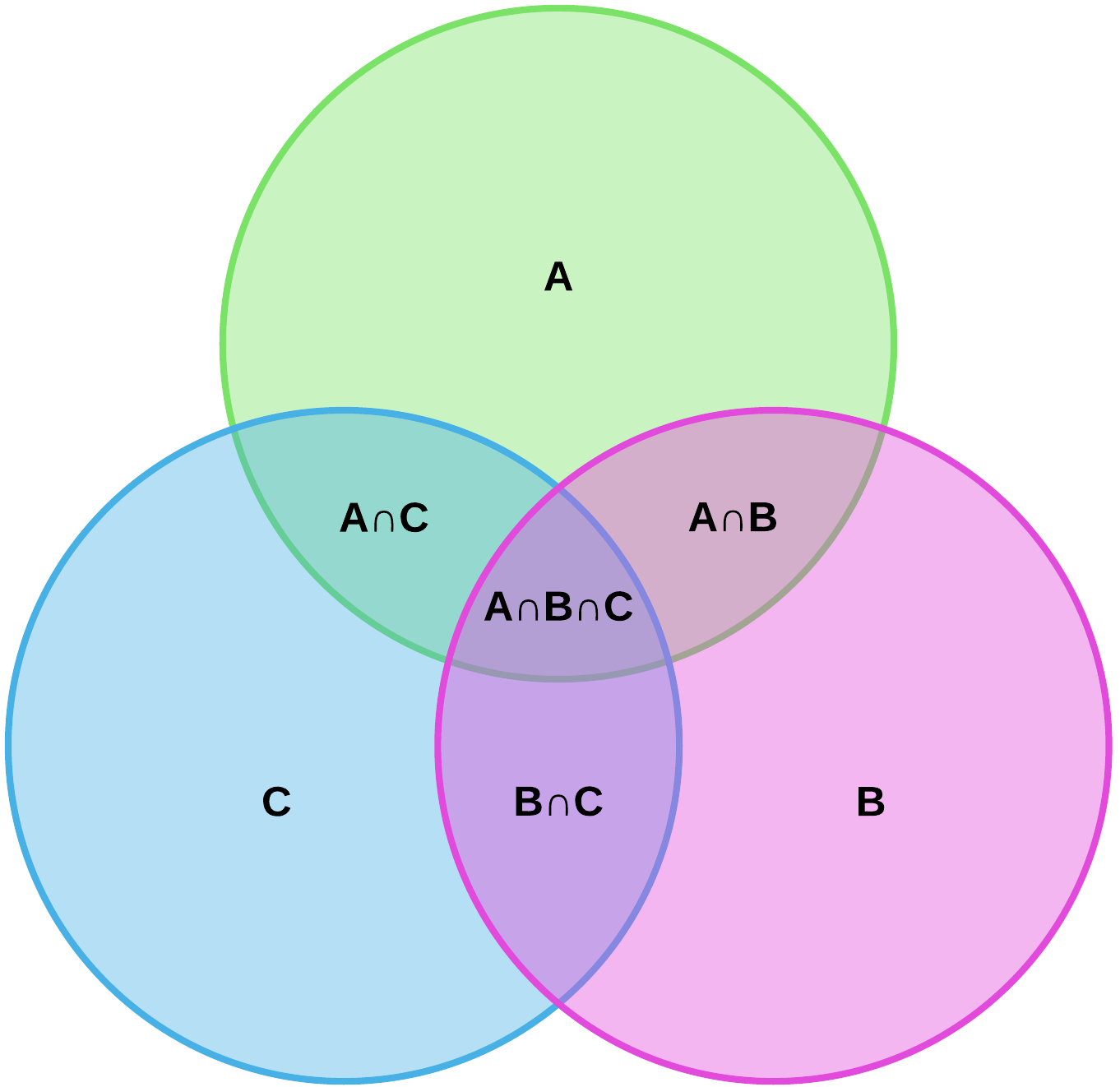
2. Understand Venn Diagram

VDIntersections

3. Count multiple events: (the number of ways A can occur) times (the number of ways B can occur)

4. Permutation: selelct r items in order from a group of n items in P(n,r) ways:

P(n,r) = n x (n-1) x (n-2) x … (n-r+2) x (n-r+1) = n!/(n-r)!

5. Factoral: n! = n x (n-1) x (n-2) x … 3 x 2 x 1

Homework:

Page 5: Ex 1.2.1, 1.2.2, 1.2.6

Page 12: Ex 1.3.1, 1.3.3

Page 18: Ex 1.4.1, 1.4.3, 1.4.5

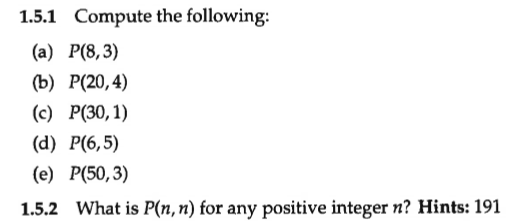
Page 21: Ex. 1.5.1 (a) (c), 1.5.2