Comments Off on Reminder: Final Exam + Spring Course
Dear all,
Please bring a calculator to school this Sunday for the final exam.
1/18 will be the first day of the Spring Semester. We have finished AoPS: Counting & Probability in fall, and will have AoPS: Number theory in the Spring.
Comments Off on AoPS_CP Week 12: Pascal’s Triangle
AoPS_CP Week 12: Pascal’s Triangle
Lesson Review:
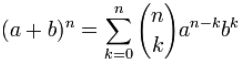
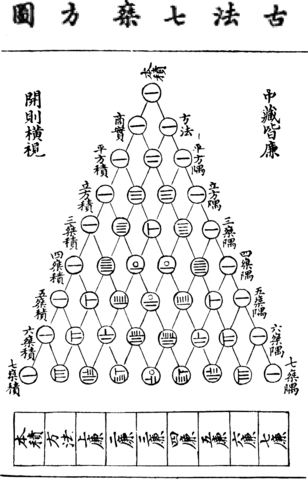
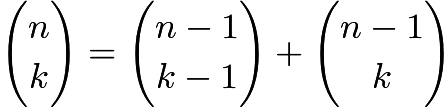
Pascal’s Triangle (also known as Yanghui Triangle in China) is a triangular array constructed by summing adjacent elements in preceding rows. It is widely used in counting and polynomial expressions.
The entries of Pascal’s Triangle are the combinations (n
choose r).
The numbers of Pascal’s Triangle also count the number of paths from the top of the triangle to the point where the number appears.
*I will be back to China from 12/10 to 12/27. Next Sunday (12/15)
we will have Mr. Xu (the teacher of AoPS: Precalculus) to teach Ch.11 Expected
Value and Ch. 13 The Hockey Stick Identity. Thank you, Mr. Xu!
There is no school on 12/22 and 12/29. Merry Christmas and
Happy New Year, everyone! See you on 1/5/2020 for our last class before the
final exam on 1/12!
Comments Off on AoPS_CP: Floor and Ceiling Functions
Here is what we have met in Problem 10.3 yesterday, about the “greatest integer less than or equal to x”. The mathematical name is “floor function”. On the other hand, we have a “ceiling function”, which is the “smallest integer greater than or equal to x”.
Comments Off on AoPS_CP Week 11: Geometric Probability
Lesson Review:
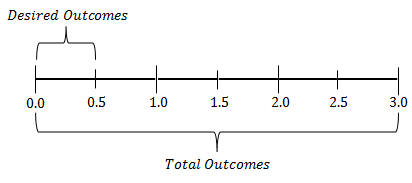
Geometric Probability can be used in situations where we don’t have a set of individual items to count; rather, we have infinitely many outcomes which can be nicely represented using some geometric object (a line segment, a region of a plane, etc). Or say, we use geometric probability when our outcomes are continuous rather than discrete.
We learned probability using lengths and areas. (In the future, you may meet some problems that require volumes.)
P (success) = Size of successful region/size of possible region
There are 3 types of geometric probabilities, one for each of the commonly used dimensions of space; length, area and volume. Target length. 1D. P(Target) = Total length. Target area. 2D. P(Target) = Total area. Target volume. 3D. P(Target) = Total volume.
Comments Off on AoPS_CP Week 10: Probability with Dependent/Independent Events
Lesson review: Today we have finished the second half of Chapter 8: Basic Probability Techniques and Chapter 9: Think about it!
Addition or Multiplication We add probabilities of exclusive events: P(A or B) = P(A) + P(B); and multiply probabilities of independent events: P(A and B) = P(A) X P(B)
Independent VS Dependent Events Independent Events: the probability that one event occurs in no way affects the probability of the other event occurring. Dependent Events: the probability of one event occurring influences the likelihood of the other event.
Avoid unnecessary computation: 1) take advantage of symmetry 2) ignore the irrelevant information 3) consider multiple events at once instead of dealing with them separately 4) be flexible, think out of the box!
Homework: Page 135: Ex 8.4.1, 8.4.4, 8.5.1, 8.5.4, 8.5.6 Page 151: Ex 9.8, 9.10, 9.12, 9.14
Comments Off on AoPS_CP Week 9: Probability & Addition, Complementary Probabilities
Flexibility Assessment:
Thanks to everyone for participating in the pilot Flexibility Assessment from Harvard Graduate School of Education. Your feedback will help to revise this assessment. This study will be carried out in Finland, Sweden, Spain, America, and China.
It’s interesting to see that most of the students in this class solved the problems in a traditional way in Part I, but developed better (more innovative) methods in Part II for the same set of problems. Perhaps because of the time constraint, or being used to the more traditional ways. We learned that for some problems, there are some “innovative strategies”. Be familiar with the properties and principles in math, you can solve problems faster, and better:)
Lesson Review:
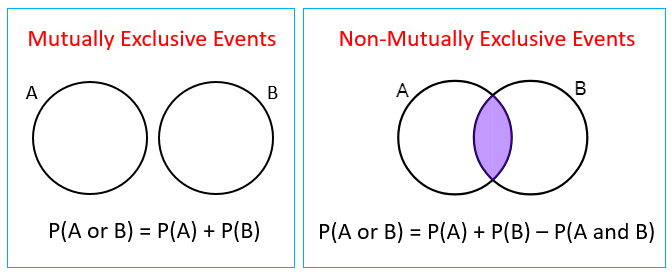
8.2 Probabilities and Addition If events A and B are mutually exclusive, then P(A or B) = P(A) + P(B) More generally, if A1, A2, …, An are mutually exclusive, then P(A1 or A2 or A3 … or An) = P(A1) + P(A2) + … + P(An)
If the events are not mutually exclusive, you have to correct for the overcounting: P(A or B) = (P(A)+P(B)-P(A and B) (think about the Venn Diagram)
8.3 Complementary Probabilities P (A does not occur) = 1 – P(A occurs)
Sometimes it is easier to calculate the “opposite” events, so the complementary method can work better than the constructive method. (Refer to Example Problem 8.6)
Comments Off on AoPS_CP Week 8: Introduction to probability
Lesson review:
Midterm Exam Paper Correction
Chapter 7: Introduction to probability 1)P(A) = Number of outcomes for A / Number of possible outcomes or P(A) = Number of successful outcomes/Number of possible outcomes 2). The range of P(A) is [0,1]
Homework: Page 114: Ex 7.2.1-7.2.2 Page 117: Ex 7.3.1 -7.3.3 Page 120: Ex 7.4.1- 7.4.5 Page 121: Ex 7.12 (Classwork)
Annabelle gave a close guess to the “Shooting star” warm-up exercise: around 80%. The accurate probability is 84%. We will discuss it in class next Sunday.